Saturday, 28 October 2017

Notes Page 3 The liminal sweet spot


The space bet     


Practice As Research 

Practice Led Research - methods, problems, strategies, wrangling my wild creative wayfaring into a path....
Suddenly a key issue is the role of the research question in my work. To be ruled by the question means sticking to a path. Without the limit of the question the project lacks reason.  Something in my personality won't commit to a question.  It might tie me down. Now I'm questioning using questions. 
What on earth is my research question?

between reason and intuition.


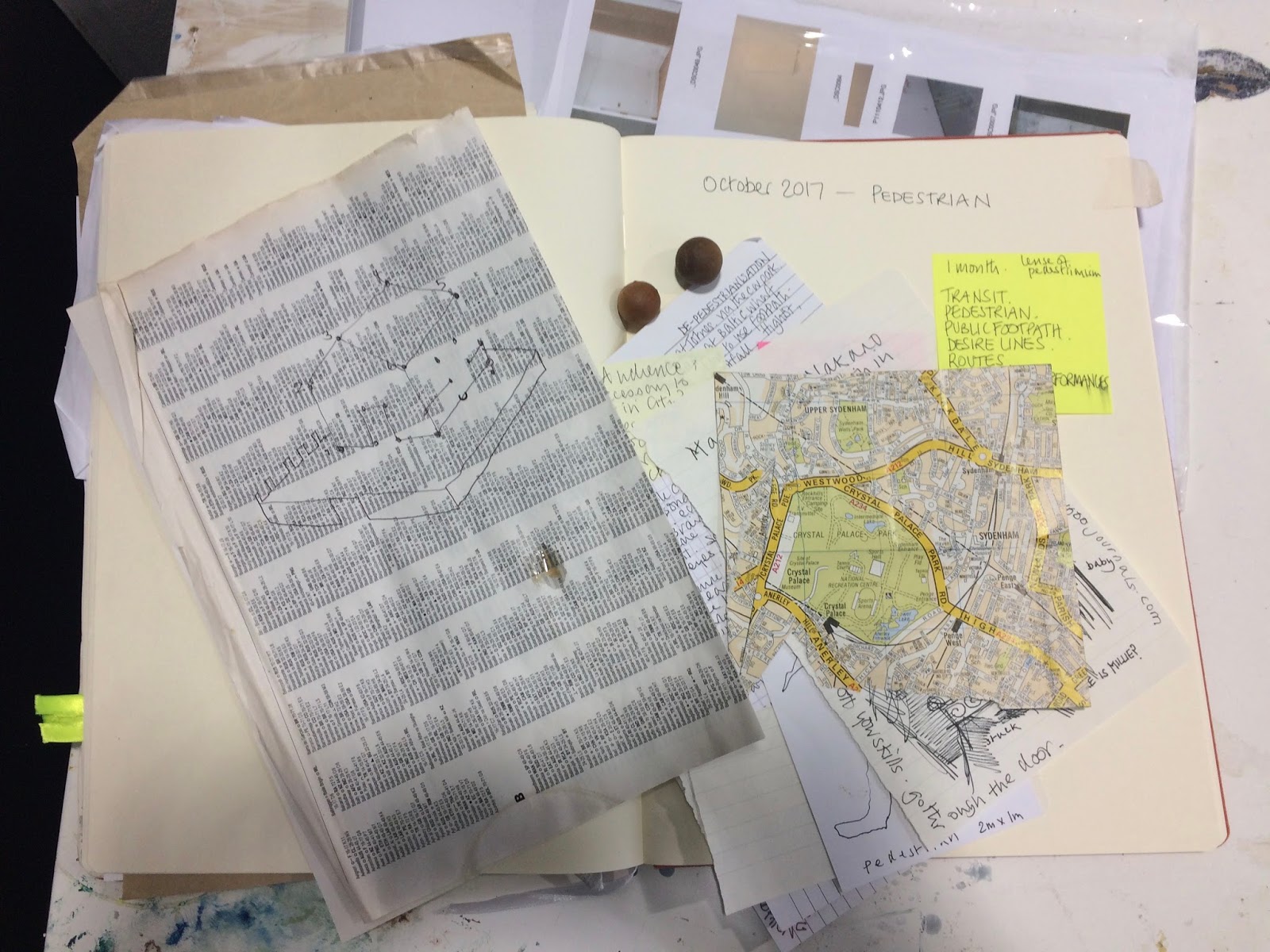
After a whole afternoon programmed to accelerate some kind of resolution to our individual proposal questions I am more lost than ever.  I was frustrated and desperate after that day. I began to feel too chaotic and reached for structure but there was no structure to be found.  Suddenly all the theory existed on its own: free-floating without being located in practice.  I haven't been making and I found myself in the dreaded frozen zone of stuckness, just not moving at all, I needed a guide a route to follow.  A map.  The paradox being - I am the one who has to make the map..... so I just carried on making my maps of the shopping walks. There is obviously a richness to being inbetween the research and the practice but I haven't exactly found the sweet spot, more of a paradoxical nightmare..

Some questions I'm playing with...
How can my concept of pedestrianism extend to drawing?
How can drawing demonstrate the relationship between logic and intuition?
How does drawing facilitate a grip on reality...
How are linear systems played out in drawing?
How useful is habitual practice in drawing?
What is lost when drawing is constrained?
What is lost when drawing is liberated from linear culture?
How can we understand linear culture through creative chaos?
Is drawing concrete? (after Murdo Macdonald)
If drawing is an act of abstraction what is concrete?
What new knowledge is there in the (newish) genre of drawing and walking?


A chance meeting with a friend using walking and drawing in her PhD enlightens me.  She pulls out Delueze from what I'm saying.  I've been avoiding Rhizomatic thinking as theory because it's complicated and I get ungrounded when I go there but she leads me back safely to biting off a bit at a time and I know now how I can't not use him.  The other idea that gets pulled out from our chat is space and she recommends Doreen Massey.  I've been looking at Thibaud and others who discuss space and I'm thinking about systems of space as extensions of linear culture somehow.  Like a shift away from the psychology of linear thinking to psychogeography. And I'm still confused but there's a nebulous thread to follow (and I'm going to colour it pink on a drawing of a map).  And Delueze says Rhizomes are maps not traces........ but one person's map is another person's trace.... like my desire lines.
Help me.




Tuesday, 17 October 2017

Notes Page 2 (bonus material)

(Drawing) is said to demonstrate the relationship between reason and intuition, between sensory perception, interpretation and the process of understanding.
From Drawing Now Introduction, Tracey (2007)

This one sentence clicked it all into place (until it shifts again...*exasperation*).

It's a subtly different statement to what we understand of drawing (as a thinking tool, a method of expression, a performative act etc).  Could it be that drawing is the bridge to or the key for the space between reason and intuition.
Could I experiment with holding both linear constraints and  non-linear thinking style in order to exist comfortably in the space between.

Do my drawings, held by formal systems yet rejecting the very conventions describe this space?

Like the sense of freedom from repetition and routine it holds things steady while exploration and experimentation happen?

Roots and Wings.

It's not a contradiction or a paradox but a potent liminal space to be in.

Is it possible to excavate how drawing creates this?


Part of Pedestrian has been walking as drawing, each foot lands as a plot or dot.  I imagine a line
. ________________._______________.___________.     in between each stride: connecting. In this process  I gain understanding via the context of drawing systems: a lens to see through when walking and this serves as a constraint. It enables me to play with the walking and be led by it, intuitively into the yet unknown.  In the liminal space between constraints and 'wilderness' I find both structure for reason and fluidity of exploration.

Notes Page 2


Collapsed cat's cradle.
3d to 2d.
Plane(d)

Squashed under paper it was once a shape in space.
It was a continual thing.          I like the conversation it creates with just hands.
It needed two people talking shapes to continue it.
Now trapped in time.  Suspended on a plane. Yet still talking of its journey and a continuous story of  looped thread.


Friday, 13 October 2017

Notes Page 1


I'm using the working title Pedestrian for current research.  The kernal of this (a project titled Pastoral) is being revisited through the lens of being (a) pedestrian ALL of my life and through questioning the pedestrian, reserved, methodology I realise I've created.  The starting point was the proposal:

A study of lines investigated under the terms of drawing in order to challenge the layers of linear systems in the real and metaphorical world.


pedestrian |pɪˈdɛstrɪən| nouna person walking rather than travelling in a vehicle: the road is so dangerous pedestrians avoid it | [as modifier] :  a pedestrian bridge.adjectivelacking inspiration or excitement; dull: disenchantment with their pedestrian lives.


Been doing some plotting.... of my shopping trips and other routines and desire lines and pedestrian routes.


And have enjoyed lots of FOLDING......
planes; flat ones and paper ones.....how to make 4d drawings? How to understand Foucalt.
The fold as a '4d thing'.  The constancy of all time and possiblilities at once.
Somehow this has to relate to the non plan, non map, non sense challenge of linear systems I've been railing against after realising I am in fact adapting constantly to a linear process (in my practice, research, my wider life).


And pricking.....
(because I think it was Klee who said a line is the distance between two points)
(and so where's the line if we just have points?)
(and don't quote me because it could just have easily been Kandinsky or even Whitehead and I'm writing in a space miles away from my copious notes and can't remember exactly..)


So it seems fairly disjointed, tenuously linked and chaotic right now and this is the tip of the iceberg: a tiny selection from pages and pages of notes and ideas.  The temptation to focus it all using a...
linear |ˈlɪnɪə| adjective1 arranged in or extending along a straight or nearly straight line: linear movement.• consisting of or predominantly formed using lines or outlines: simple linear designs.• involving one dimension only: linear elasticity.• Mathematics able to be represented by a straight line on a graph:linear functions.• Mathematics involving or exhibiting directly proportional change in two related quantities: linear relationship.
2 progressing from one stage to another in a single series of steps; sequential: a linear narrative. 

...approach is strong.  Fear of losing the ideas, of revealing the whole experience when researching through practice (where practice for me IS me), OF GETTING LOST makes it all feel very vulnerable.


My notes on:
Murdo MacDonald: Drawing - Notes on an everyday art (2012)
I read this again and again and found that the questions I had were redundant!!!It answered a lot of what I had been pondering.

Everyday art - The working title for my proposal (concerned with challenging linear systems) is ‘Pedestrian’. I have recently discovered the word Quotidian. It is a complicated sounding word that means ‘everyday’. Drawing is not so everyday or pedestrian: a simple drawn line seems pedestrian but is extraordinarily complicated. 
As Murdo says it can be the link between us and our realities, an existential bridge, it can be duplicitous,
contrary….contentious and subversive, it can be many things. 

Is drawing concrete or even gestural? I have always assumed that, yes it’s gestural but not always concrete but now I’m confused. It’s not as simple (pedestrian) as assuming that paperless drawing*, something that I like to explore, for instance, isn’t concrete.

See Bram Arnold - Tuan YF Space and Place: the perspective of experience (Concrete Quote) ‘an object or place achieves concrete reality when our experience of it is total, that is, through all the senses, as well as with the active and reflective mind’

Im investigating linear systems through drawing to challenge my own working/thinking process because I’ve conditioned myself to work rationally, repetitively and without representation (of me or my subject) as a coping strategy against scatterbrain tendencies. 
Murdo observes that ‘representation/resemblance’ comes into play whether you seek it or not or even actively dispense with it. 
As to why this occurs is another dimension to my research.  However abstract, I realised my drawing transmits some reference whether it’s optically in the drawing or contributed/projected by the viewer or is tapping into a universal knowledge….Murdo is more succinct - abstraction IS drawing. 

The inversion of plane line and point illustrates how I adapted my research method/process and am now turning it around again.
From an indexical plotting - leading from point to point to create a line of thought/notion, a rational transect I designed to be able to control the results - to now trying to journey in a meandering gyroscopic sense, a bit like a Mobius strip continuously revisiting, with no beginning or end or plane or corner, something that looks like a straight line but in fact has nothing linear to it. Like an everyday labyrinth.

The text itself is an example of non-linear-ness.  Each paragraph can be read in any order. In form it reads like a list. I am using lists in Pedestrian. Lists are organised in appearance but this one is gyroscopic I think.  And each point is stand alone. Able to revisit any one in any permutation.


Student

Now I am a student again.

Orientating.  No map.  New territory.
Found the library.  Safe.
Stuff to remember piling up in my memory.
Tried to download by making lists.
There are no lines to follow.
It's crazy paving.

Some images from my induction week.

 from a wall in a life drawing room


 from a donkey in the same 
                                                                     life drawing room

 my allocated space *home*

 my wall in my allocated space *home*


Friday, 21 April 2017

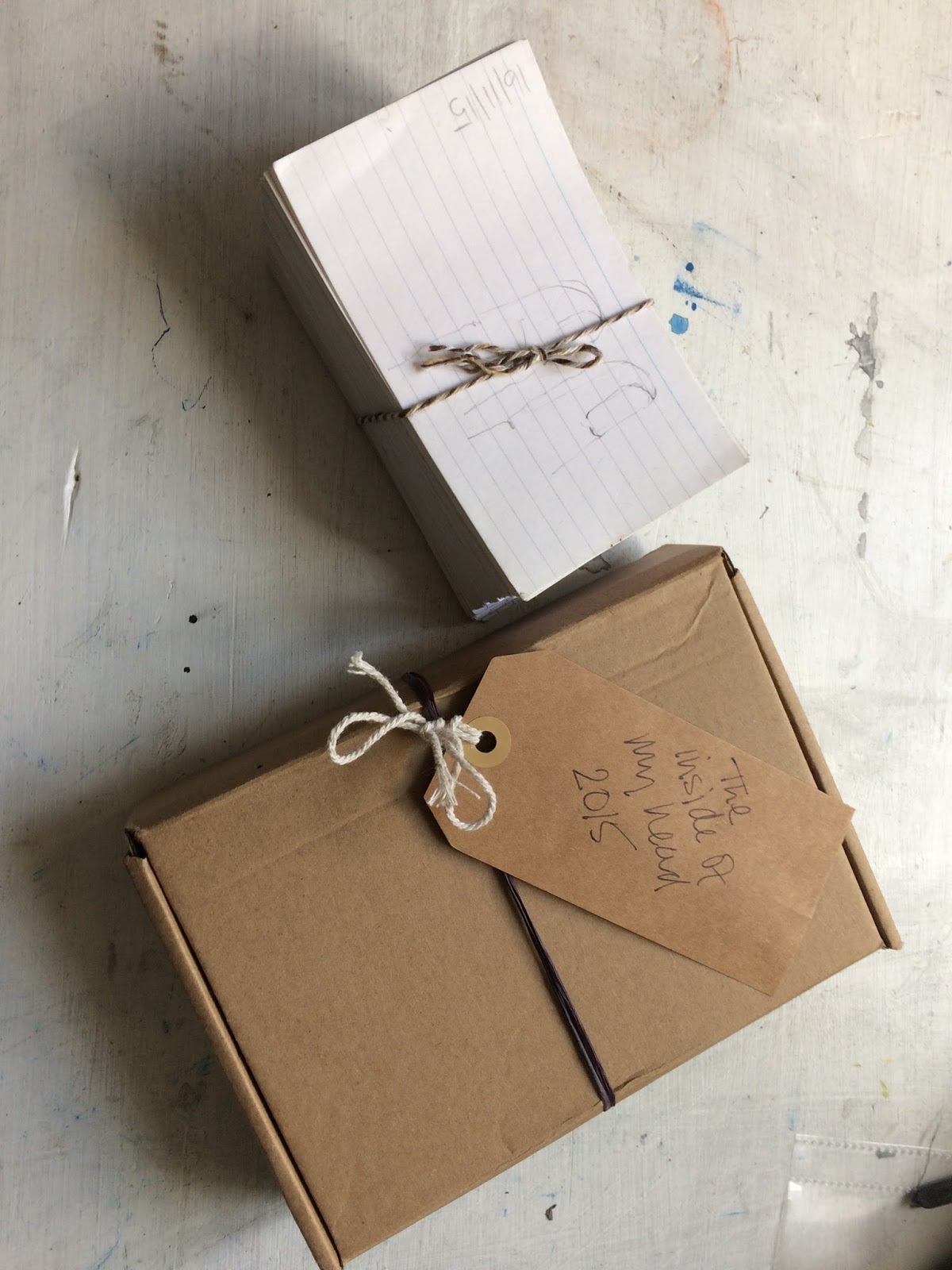
The inside of my head


over the period of a year i recorded how i felt on index cards every morning

i  also made a daily drawing of my right hand

i have yet to analyse this year as data

and correlate the findings

i am presuming the marks will reveal a clue to my feelings on any given day elaborating what is written in words 


Daily Bread


each day i draw bread


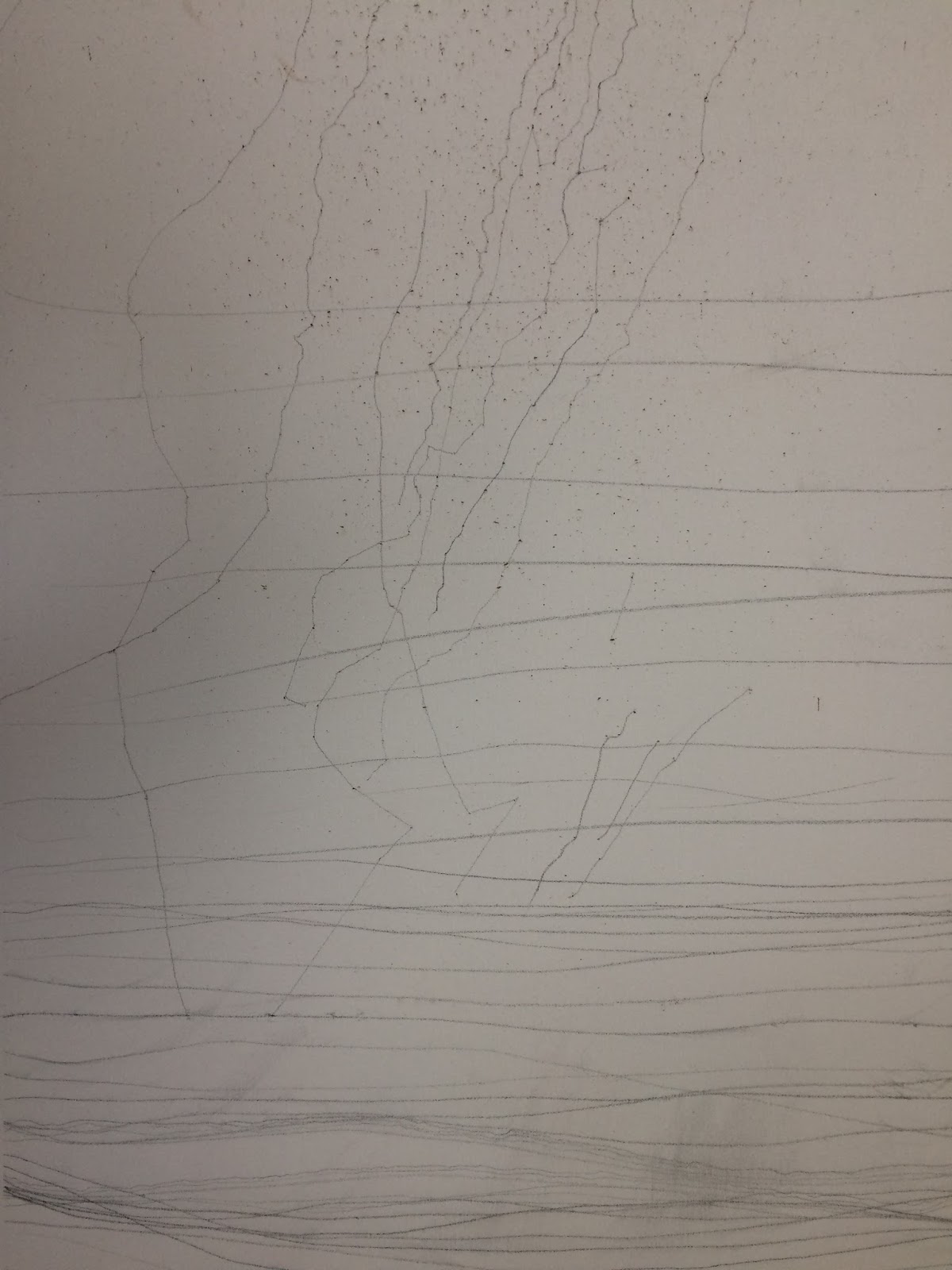
tracks


a large canvas placed in my hallway for a few months
everytime i pass i wipe a pencil along it
everytime the dog passes she shakes the river dart all over it
i have begun to erase the tracks of the pencil as i make more
the family traffic disturbs more of them
i try to find them again
tracing them with another pencil

the constant search for the track or path to follow is redolent of my current existence
as i repeatedly register and re-register the lines there emerges an index of preformed routes
the research is ongoing
the findings are not conclusive
they just lead to more lines

and then the lines become words here

the niggling issues emerge as i work
i made a border of masking tape and so although this is an experimental investigative piece i still employed formalities like a clean framed boundary and a canvas support
why
i am uncomfortable about the need to use a pencil
the generation of marks should emerge directly from the family movement
it feels as though a step has been breached


Pasturised


Map of desire lines


Friday, 18 March 2016

Drawing meets meditation

Exploring drawing has taken me down lots
of little paths and some big ones too.
One of the least trodden is the idea that
drawing is a form of meditation.  In its action
and in its reading.  I say least trodden because
I find the idea so special and meaningful I rarely
make an obvious point of it in my work.
But it's always there, this latent, magical,
intangible benefit to me, the drawer and also - in
experiencing the drawing - the viewer.
The process as I have discovered over the years is
twofold.  As I draw I benefit from a deep connection
with my being self.  My bodily activity feeds back to my meditative mind an
essence of presence, an ability to remain in the moment only noticing my
marks, the sound of my pencil, the touch of the paper....  In turn this state of
meditation is where I can override the doubt, the thinking me's critical
turgid stream of negativity, the block, the fear;  it doesn't matter what
or how I'm drawing or why, the only thing of importance in that moment is the
action.
And so it brings me to the project I have been working on with Tonja Mills,
a great friend of mine who has been exploring meditation and well being for
a long time.  We have created a series of workshops, retreats, and courses
providing the space and tools to enable this phenomenal process.
We've put the information here:
www.drawingthroughmeditation.weebly.com
It would be great if you could share it around, we would really like this to grow
and be able to offer it widely.
I am also exploring the idea of how the activity of drawing (mindfully) can
release ideas and what its importance is in the process of art making.  It's not
new territory but it's a culmination of where the performative aspect of
my drawing has been going for quite a while.  I'll put up some of the research
images in my next blog.
If I get time...........................!


Graphic Memoir project

Over on https://spacegirlproject.blogspot.com/ I began a  blog for my developing PhD research The Graphic Memoir as a Device for Healing. I ...