Drawing locates me anchors grounds me - connection (pencil meeting paper in this case) with the/a material world (touch) is confirmation of my existence does. As does walking.
Ingold: The landscape is a tapestry within which lives are woven, not a stage performed on. "In all these ways-in their texture, their temporality and their literal embeddedness in a landscape of habitation - footprints differ from stamps. Perhaps, then they should be likened to inscriptions, to lines traced in a surface rather than stamped upon it......in printing there is no relation between the technically effective gesture and the graphic forms it serves to deliver".
I've been dwelling here for a bit, wondering about the likeness of footprints to "as the actual trace of a gestural movement" rather than a print. Thinking about the 'sensory experience of pressure commonly described as touch.
What I know:
In print the point of connection is the plate and the surface...
The print is rolled, in a pre-made form, it doesn't 'journey' through the landscape of the 'ground'
Print doesn't feel embodied, but inscription can happen- Intaglio work - and this process could be seen as embodied and investigating touch.
Saturday, 28 October 2017

Notes Page 4
A plotting of regular journeys around the supermarket using shopping lists as orientation. (What is the frequency of the journeys/walks? The inclusion of time along with movement would add a 'vertical axis'.)
I use a rough map made from memory of the store and then draw the route on this according to the shopping list (this acts as the score) taking a print from carbon paper underneath to arrive at the documented linear journey.
These results are simplified lines representing the route (as documents/records and/or non-maps)
I've overlaid some of them to experiment with repetition. (I'd like to expand the visual experimentation)
A direct response to the route. (As...... subway drawings) The body is absent in the process and there is no dialogue between the ideas and the materials. it's printed so the gesture (see notes on embodiment/gesture - Avis Newman) is 'distilled'
There is no sense of movement (the walk itself) from the original activity and the non-maps.
 As a functional drawing of words to assist memory - it's interesting to see sensitive mark/composition (who to evidence this?) emerge from the printing, a technique I wanted to employ to dissolve authorship and interrupt touch. Drawing locates me, anchors, grounds me with connection (pencil meeting paper in this case) with the/a material world via touch and is confirmation of my existence . So using print -and photocopying- to interrupt this can interrogate why: the point of connection being the plate and the surface and a certain amount of mechanisation is in action, the emphasis on the aesthetic seems more important than the embodied experience of drawing.
Is there an emotional language beyond the grammar of drawing, in the line itself?
When I look at the resulting drawings I feel something - and I don't believe it's my subjective autoethnographical? memory of the walks/journeys.
I'm beginning to use my invented word pseudocartography.....


It relates to Ingold's theory about text being linear. The shorthand is like a cuneiform - each word or phrase is closer to being read at once, face on rather than in a line although it's still read left to right and makes a linear sentence, the characters are almost like phonic bursts and closer to ideas than words constructed in longhand. Looking at Mum's process like this and the lists with non-maps side by side is giving me more ideas but also insight into the way my non-linear thinking is operating. I was trying to organise my development by forcing a linear iterative development from piece to piece but this has danced about and reflected back (mining old work) and forth and round and up etc. Gyroscopic and (flat ontology - DeLander) rhizomatic (Delueze).
Notes Page 3 The liminal sweet spot
The space bet
Practice As Research
Practice Led Research - methods, problems, strategies, wrangling my wild creative wayfaring into a path....
Suddenly a key issue is the role of the research question in my work. To be ruled by the question means sticking to a path. Without the limit of the question the project lacks reason. Something in my personality won't commit to a question. It might tie me down. Now I'm questioning using questions.
What on earth is my research question?
between reason and intuition.
After a whole afternoon programmed to accelerate some kind of resolution to our individual proposal questions I am more lost than ever. I was frustrated and desperate after that day. I began to feel too chaotic and reached for structure but there was no structure to be found. Suddenly all the theory existed on its own: free-floating without being located in practice. I haven't been making and I found myself in the dreaded frozen zone of stuckness, just not moving at all, I needed a guide a route to follow. A map. The paradox being - I am the one who has to make the map..... so I just carried on making my maps of the shopping walks. There is obviously a richness to being inbetween the research and the practice but I haven't exactly found the sweet spot, more of a paradoxical nightmare..
Some questions I'm playing with...
How can my concept of pedestrianism extend to drawing?
How can drawing demonstrate the relationship between logic and intuition?
How does drawing facilitate a grip on reality...
How are linear systems played out in drawing?
How useful is habitual practice in drawing?
What is lost when drawing is constrained?
What is lost when drawing is liberated from linear culture?
How can we understand linear culture through creative chaos?
Is drawing concrete? (after Murdo Macdonald)
If drawing is an act of abstraction what is concrete?
What new knowledge is there in the (newish) genre of drawing and walking?
A chance meeting with a friend using walking and drawing in her PhD enlightens me. She pulls out Delueze from what I'm saying. I've been avoiding Rhizomatic thinking as theory because it's complicated and I get ungrounded when I go there but she leads me back safely to biting off a bit at a time and I know now how I can't not use him. The other idea that gets pulled out from our chat is space and she recommends Doreen Massey. I've been looking at Thibaud and others who discuss space and I'm thinking about systems of space as extensions of linear culture somehow. Like a shift away from the psychology of linear thinking to psychogeography. And I'm still confused but there's a nebulous thread to follow (and I'm going to colour it pink on a drawing of a map). And Delueze says Rhizomes are maps not traces........ but one person's map is another person's trace.... like my desire lines.
Help me.
Tuesday, 17 October 2017
Notes Page 2 (bonus material)
(Drawing) is said to demonstrate the relationship between reason and intuition, between sensory perception, interpretation and the process of understanding.
From Drawing Now Introduction, Tracey (2007)
This one sentence clicked it all into place (until it shifts again...*exasperation*).
It's a subtly different statement to what we understand of drawing (as a thinking tool, a method of expression, a performative act etc). Could it be that drawing is the bridge to or the key for the space between reason and intuition.
Could I experiment with holding both linear constraints and non-linear thinking style in order to exist comfortably in the space between.
Do my drawings, held by formal systems yet rejecting the very conventions describe this space?
 Like the sense of freedom from repetition and routine it holds things steady while exploration and experimentation happen?
Roots and Wings.
It's not a contradiction or a paradox but a potent liminal space to be in.
Is it possible to excavate how drawing creates this?
Part of Pedestrian has been walking as drawing, each foot lands as a plot or dot. I imagine a line
. ________________._______________.___________. in between each stride: connecting. In this process I gain understanding via the context of drawing systems: a lens to see through when walking and this serves as a constraint. It enables me to play with the walking and be led by it, intuitively into the yet unknown. In the liminal space between constraints and 'wilderness' I find both structure for reason and fluidity of exploration.
From Drawing Now Introduction, Tracey (2007)
This one sentence clicked it all into place (until it shifts again...*exasperation*).
It's a subtly different statement to what we understand of drawing (as a thinking tool, a method of expression, a performative act etc). Could it be that drawing is the bridge to or the key for the space between reason and intuition.
Could I experiment with holding both linear constraints and non-linear thinking style in order to exist comfortably in the space between.
Do my drawings, held by formal systems yet rejecting the very conventions describe this space?
 Like the sense of freedom from repetition and routine it holds things steady while exploration and experimentation happen?
Roots and Wings.
It's not a contradiction or a paradox but a potent liminal space to be in.
Is it possible to excavate how drawing creates this?
Part of Pedestrian has been walking as drawing, each foot lands as a plot or dot. I imagine a line
. ________________._______________.___________. in between each stride: connecting. In this process I gain understanding via the context of drawing systems: a lens to see through when walking and this serves as a constraint. It enables me to play with the walking and be led by it, intuitively into the yet unknown. In the liminal space between constraints and 'wilderness' I find both structure for reason and fluidity of exploration.
Notes Page 2

Collapsed cat's cradle.
3d to 2d.
Plane(d)
Squashed under paper it was once a shape in space.
It was a continual thing. I like the conversation it creates with just hands.
It needed two people talking shapes to continue it.
Now trapped in time. Suspended on a plane. Yet still talking of its journey and a continuous story of looped thread.
Friday, 13 October 2017
Notes Page 1
I'm using the working title Pedestrian for current research. The kernal of this (a project titled Pastoral) is being revisited through the lens of being (a) pedestrian ALL of my life and through questioning the pedestrian, reserved, methodology I realise I've created. The starting point was the proposal:
A study of lines investigated under the terms of drawing in order to challenge the layers of linear systems in the real and metaphorical world.
pedestrian |pɪˈdɛstrɪən| nouna person walking rather than travelling in a vehicle: the road is so dangerous pedestrians avoid it | [as modifier] : a pedestrian bridge.adjectivelacking inspiration or excitement; dull: disenchantment with their pedestrian lives.
Been doing some plotting.... of my shopping trips and other routines and desire lines and pedestrian routes.
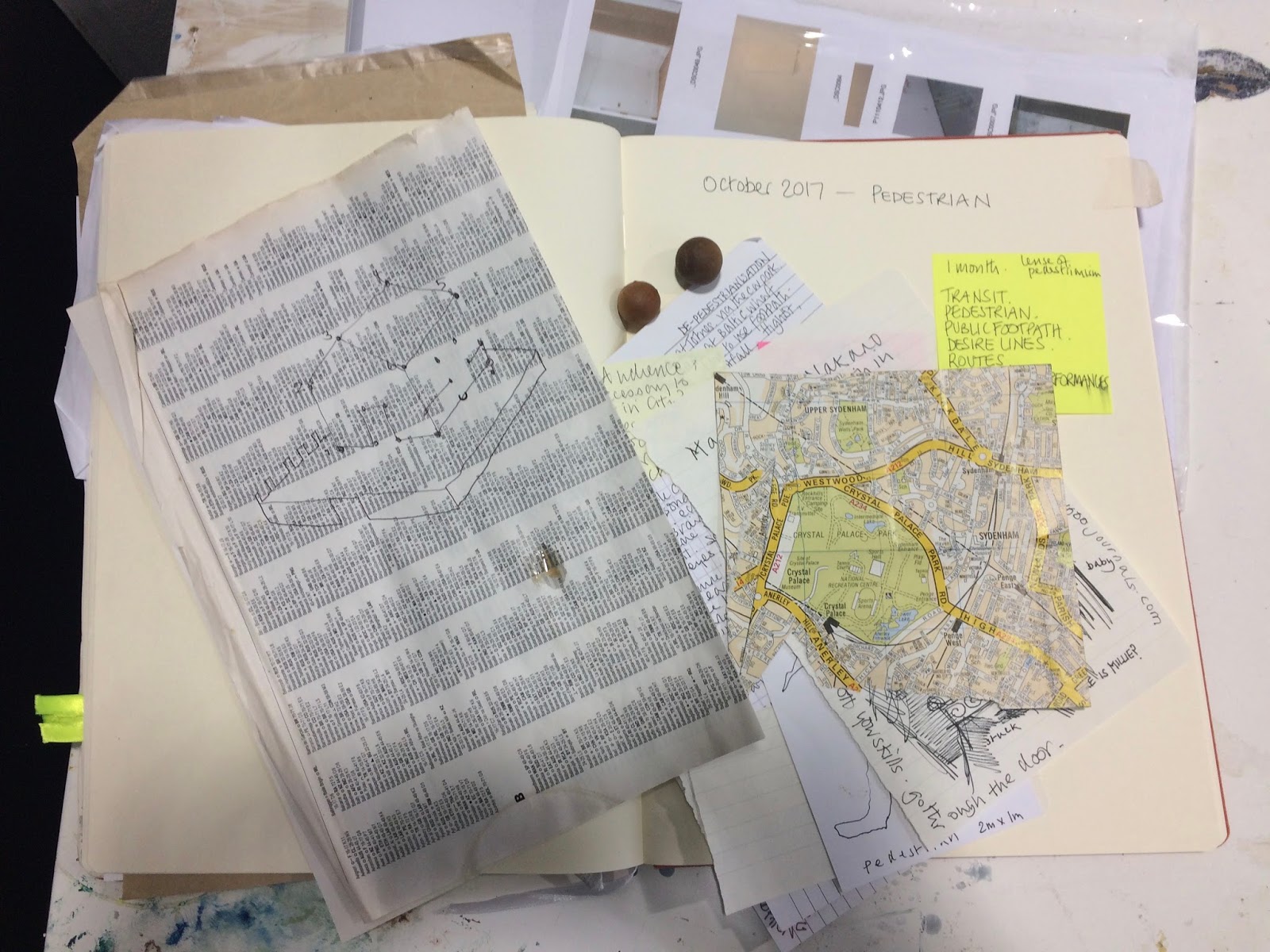
And have enjoyed lots of FOLDING......
planes; flat ones and paper ones.....how to make 4d drawings? How to understand Foucalt.
The fold as a '4d thing'. The constancy of all time and possiblilities at once.
Somehow this has to relate to the non plan, non map, non sense challenge of linear systems I've been railing against after realising I am in fact adapting constantly to a linear process (in my practice, research, my wider life).

And pricking.....
(because I think it was Klee who said a line is the distance between two points)
(and so where's the line if we just have points?)
(and don't quote me because it could just have easily been Kandinsky or even Whitehead and I'm writing in a space miles away from my copious notes and can't remember exactly..)


So it seems fairly disjointed, tenuously linked and chaotic right now and this is the tip of the iceberg: a tiny selection from pages and pages of notes and ideas. The temptation to focus it all using a...
linear |ˈlɪnɪə| adjective1 arranged in or extending along a straight or nearly straight line: linear movement.• consisting of or predominantly formed using lines or outlines: simple linear designs.• involving one dimension only: linear elasticity.• Mathematics able to be represented by a straight line on a graph:linear functions.• Mathematics involving or exhibiting directly proportional change in two related quantities: linear relationship.
2 progressing from one stage to another in a single series of steps; sequential: a linear narrative.
...approach is strong. Fear of losing the ideas, of revealing the whole experience when researching through practice (where practice for me IS me), OF GETTING LOST makes it all feel very vulnerable.
My notes on:
Murdo MacDonald: Drawing - Notes on an everyday art (2012)
I read this again and again and found that the questions I had were redundant!!!It answered a lot of what I had been pondering.
Everyday art - The working title for my proposal (concerned with challenging linear systems) is ‘Pedestrian’. I have recently discovered the word Quotidian. It is a complicated sounding word that means ‘everyday’. Drawing is not so everyday or pedestrian: a simple drawn line seems pedestrian but is extraordinarily complicated.
As Murdo says it can be the link between us and our realities, an existential bridge, it can be duplicitous,
contrary….contentious and subversive, it can be many things.
Is drawing concrete or even gestural? I have always assumed that, yes it’s gestural but not always concrete but now I’m confused. It’s not as simple (pedestrian) as assuming that paperless drawing*, something that I like to explore, for instance, isn’t concrete.
See Bram Arnold - Tuan YF Space and Place: the perspective of experience (Concrete Quote) ‘an object or place achieves concrete reality when our experience of it is total, that is, through all the senses, as well as with the active and reflective mind’
Im investigating linear systems through drawing to challenge my own working/thinking process because I’ve conditioned myself to work rationally, repetitively and without representation (of me or my subject) as a coping strategy against scatterbrain tendencies.
Murdo observes that ‘representation/resemblance’ comes into play whether you seek it or not or even actively dispense with it.
As to why this occurs is another dimension to my research. However abstract, I realised my drawing transmits some reference whether it’s optically in the drawing or contributed/projected by the viewer or is tapping into a universal knowledge….Murdo is more succinct - abstraction IS drawing.
The inversion of plane line and point illustrates how I adapted my research method/process and am now turning it around again.
From an indexical plotting - leading from point to point to create a line of thought/notion, a rational transect I designed to be able to control the results - to now trying to journey in a meandering gyroscopic sense, a bit like a Mobius strip continuously revisiting, with no beginning or end or plane or corner, something that looks like a straight line but in fact has nothing linear to it. Like an everyday labyrinth.
The text itself is an example of non-linear-ness. Each paragraph can be read in any order. In form it reads like a list. I am using lists in Pedestrian. Lists are organised in appearance but this one is gyroscopic I think. And each point is stand alone. Able to revisit any one in any permutation.
Student
Now I am a student again.
Orientating. No map. New territory.
Found the library. Safe.
Stuff to remember piling up in my memory.
Tried to download by making lists.
There are no lines to follow.
It's crazy paving.
Some images from my induction week.
 from a wall in a life drawing room
 from a donkey in the same
life drawing room
 my allocated space *home*
 my wall in my allocated space *home*
Friday, 21 April 2017
The inside of my head

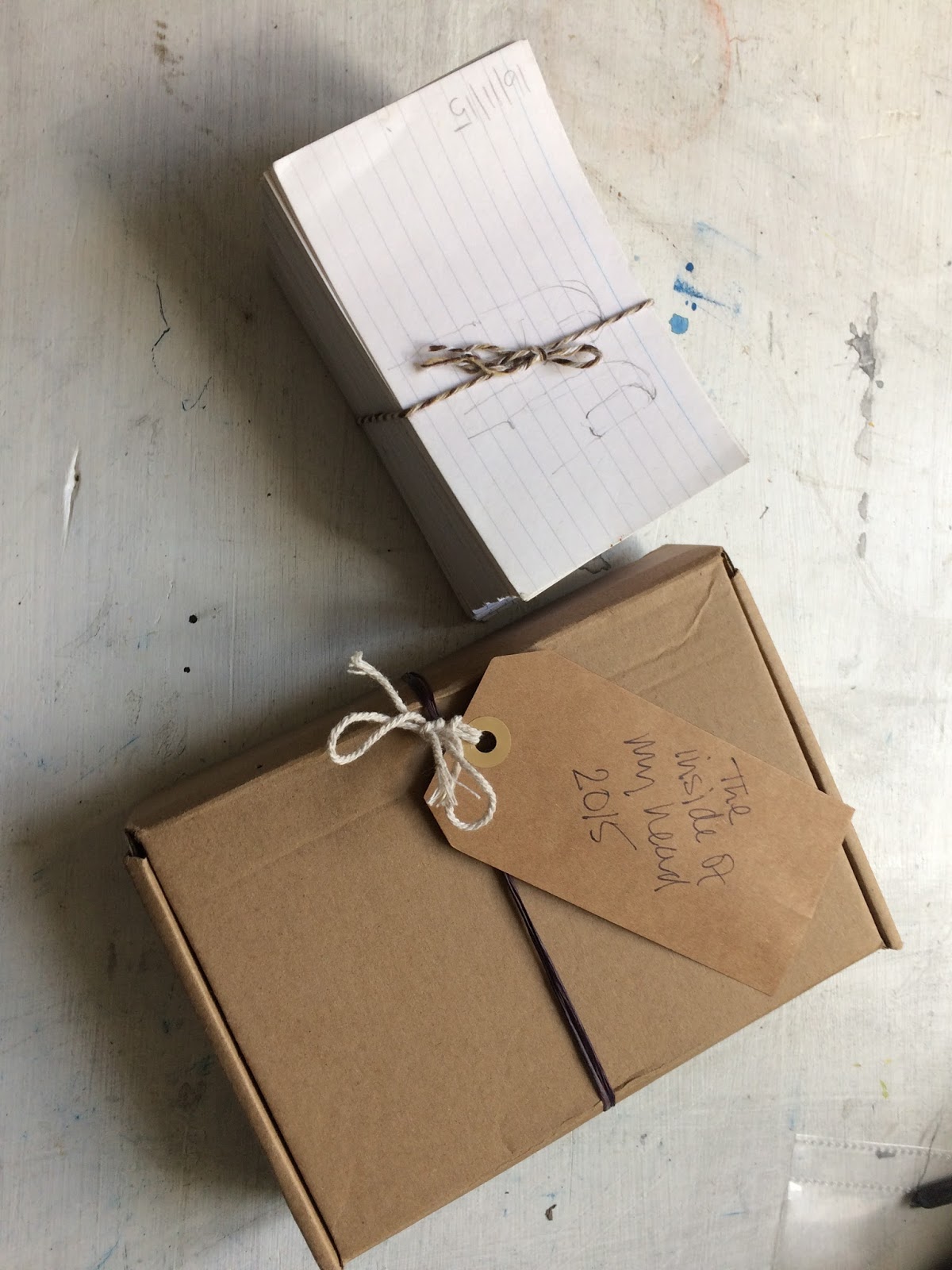
over the period of a year i recorded how i felt on index cards every morning
i also made a daily drawing of my right hand
i have yet to analyse this year as data
and correlate the findings
i am presuming the marks will reveal a clue to my feelings on any given day elaborating what is written in words

tracks
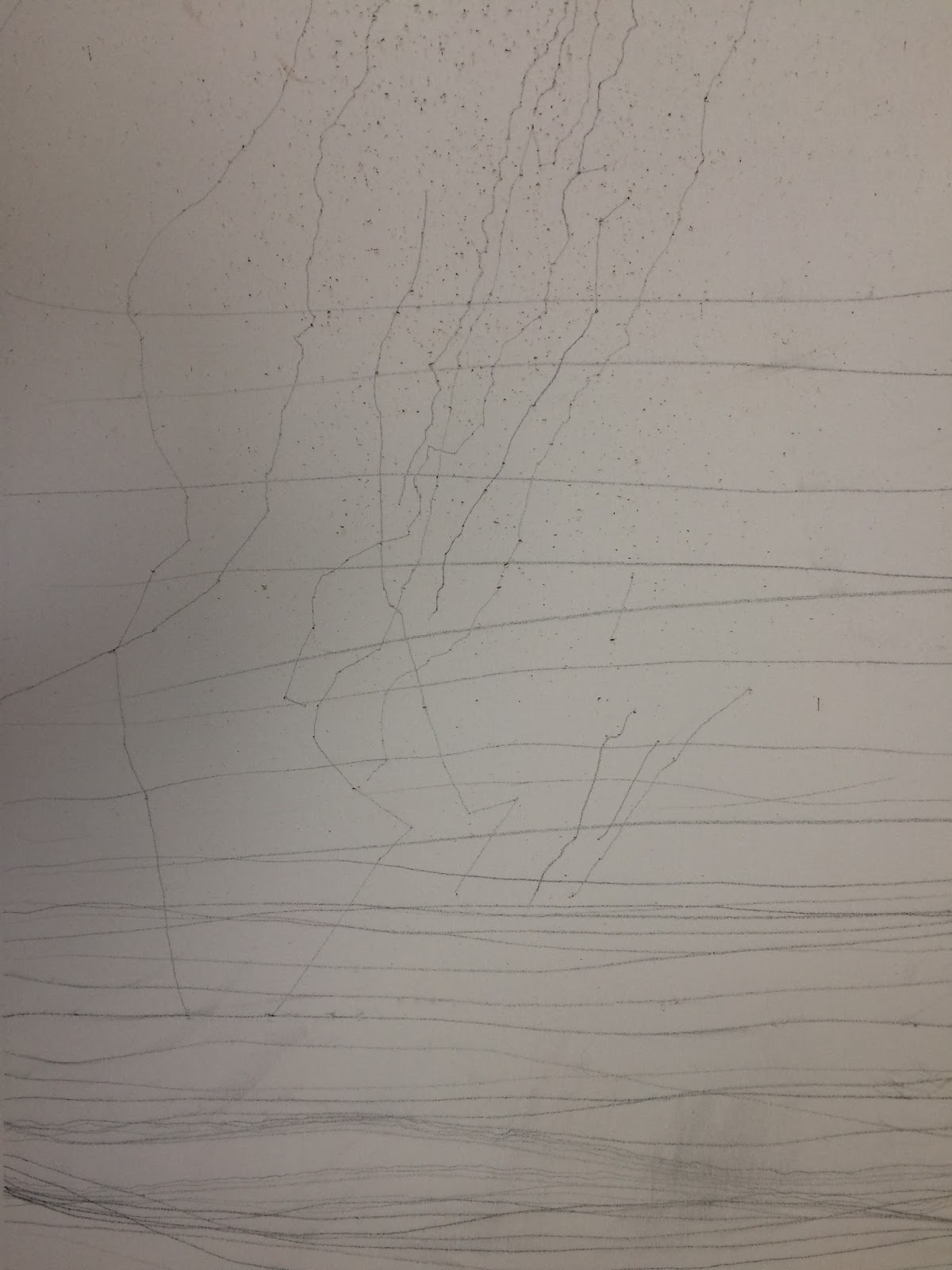

a large canvas placed in my hallway for a few months
everytime i pass i wipe a pencil along it
everytime the dog passes she shakes the river dart all over it
i have begun to erase the tracks of the pencil as i make more
the family traffic disturbs more of them
i try to find them again
tracing them with another pencil
the constant search for the track or path to follow is redolent of my current existence
as i repeatedly register and re-register the lines there emerges an index of preformed routes
the research is ongoing
the findings are not conclusive
they just lead to more lines
and then the lines become words here
the niggling issues emerge as i work
i made a border of masking tape and so although this is an experimental investigative piece i still employed formalities like a clean framed boundary and a canvas support
why
i am uncomfortable about the need to use a pencil
the generation of marks should emerge directly from the family movement
it feels as though a step has been breached


Subscribe to:
Posts (Atom)
-
Over on https://spacegirlproject.blogspot.com/ I began a blog for my developing PhD research The Graphic Memoir as a Device for Healing. I ...

